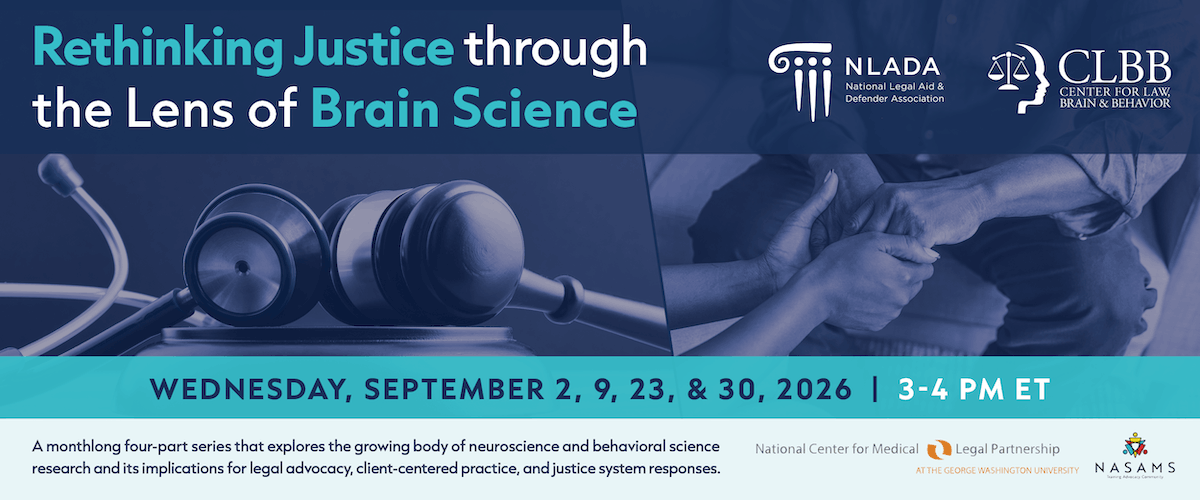
FREE Four-Part Webinar Series
Wednesday, September 2, 9, 23 and 30 | 3:00 p.m. – 4:00 p.m. EDT
What if some of the justice system's most common assumptions about behavior, memory, addiction and decision-making are wrong?
This free four-part webinar series explores how neuroscience and behavioral science are reshaping our understanding of human behavior and what that means for legal advocacy, client-centered practice and justice system reform. Covering topics including adolescent brain development, trauma, substance use disorders, memory, aging, and cognitive decline, each session connects current research to practical strategies for strengthening representation and improving outcomes.
Designed for attorneys, social workers, mitigation specialists, investigators, judges, policymakers, and other justice professionals, this series offers actionable insights to help build a more fair, effective and humane justice system.
September 2nd: The Developing Brain on Trial: Updates on Juvenile and Young Adult Justice
Date: September 2nd, 3:00-4:00PM ET
Neuroscience has transformed what we know about behavior in youth. Research shows that the brain regions responsible for impulse control, judgment, and foresight continue developing into the mid-twenties. This session aims to support legal-decision makers in aligning legal practice with current research about brain development and capacity for change. The speaker will discuss the implications of this research on topics such as mitigation, sentencing, and plea bargaining. In addition to distilling the current state of research, this session will discuss relevant key case law in the areas of juvenile and young adult sentencing.
Instructor: Robert Kinscherff, PhD, JD - Executive Director, MGH Center for Law, Brain & Behavior and Professor, William James College
September 9th: Debunking Myths: Understanding The Science of Trauma and Memor
Date: September 9, 3:00-4:00PM ET
Trauma and memory are among the most misunderstood issues in the legal system. From criminal trials to asylum hearings, misconceptions about trauma and memory undermine the fairness and effectiveness of the legal system. This session will discuss how trauma impacts both brain structure and function, altering key regions involved in judgment, emotion regulation, impulse control, and memory. Drawing on recent advances in neuroscience and epigenetics, it examines how adverse childhood experiences, post-traumatic stress disorder, and intergenerational trauma affect behavior and decision-making in legally relevant contexts. Additionally, this session will discuss current scientific understandings of memory—including how the formation, storage and retrieval of memories may be influenced or distorted by other cortical processes or by illness, injury, or traumatic experiences—with significant implications on false confessions and eyewitness testimony. Equipped with current scientific understandings of trauma and memory, this session aims to prepare attendees to pursue more fair, effective, and humane legal responses.
Instructor: Judith Edersheim, JD, MD - Co-Director, MGH Center for Law, Brain & Behavior; Assistant Clinical Professor, Harvard Medical School; and Psychiatrist, Massachusetts General Hospital
September 23rd: Addictions In Court: The Science of Addiction and Implications for Practice and Policy
Date: September 23, 3:00-4:00PM ET
Scientific advances over the past two decades have transformed our understanding of addiction and substance use disorders. Despite these developments, the American legal system often continues to rely on outdated assumptions and approaches to identifying, assessing, and responding to addiction-related behaviors. This session examines the current science of addiction, including the neurological, psychological, and behavioral factors that influence substance use disorders. Participants will discuss the practical implications of modern addiction research on legal representation, sentencing, treatment recommendations, diversion strategies, and broader criminal legal policy.
Instructor: Stephanie Tabashneck, PsyD, JD - Project Director, MGH Center for Law, Brain & Behavior and Senior Fellow in Law and Applied Neuroscience, Harvard Law School
September 30th: Understanding Cognitive Decline and the Financial Exploitation of Older Adults
Date: September 30, 3:00-4:00PM ET
As populations age, cognitive decline and financial exploitation are becoming urgent and complex challenges. This session will translate the latest scientific and medical understandings of cognitive aging and decision-making into practical guidance for legal decision-makers. Speakers will also discuss the core legal issues that emerge within these contexts and topics such as supported decision-making and advanced directives. In doing so, this session aims to help attendees recognize, prevent, and respond to cognitive decline and potential exploitation while protecting the autonomy and dignity of older adults.
Instructors:
- Robert Kinscherff, PhD, JD - Executive Director, MGH Center for Law, Brain & Behavior and Professor, William James College
- Rohan Kandeshwarath, JD - Equal Justice Works Fellow, MGH Center for Law, Brain & Behavior
Related Links
NLADA Mutual Insurance Co., RRG